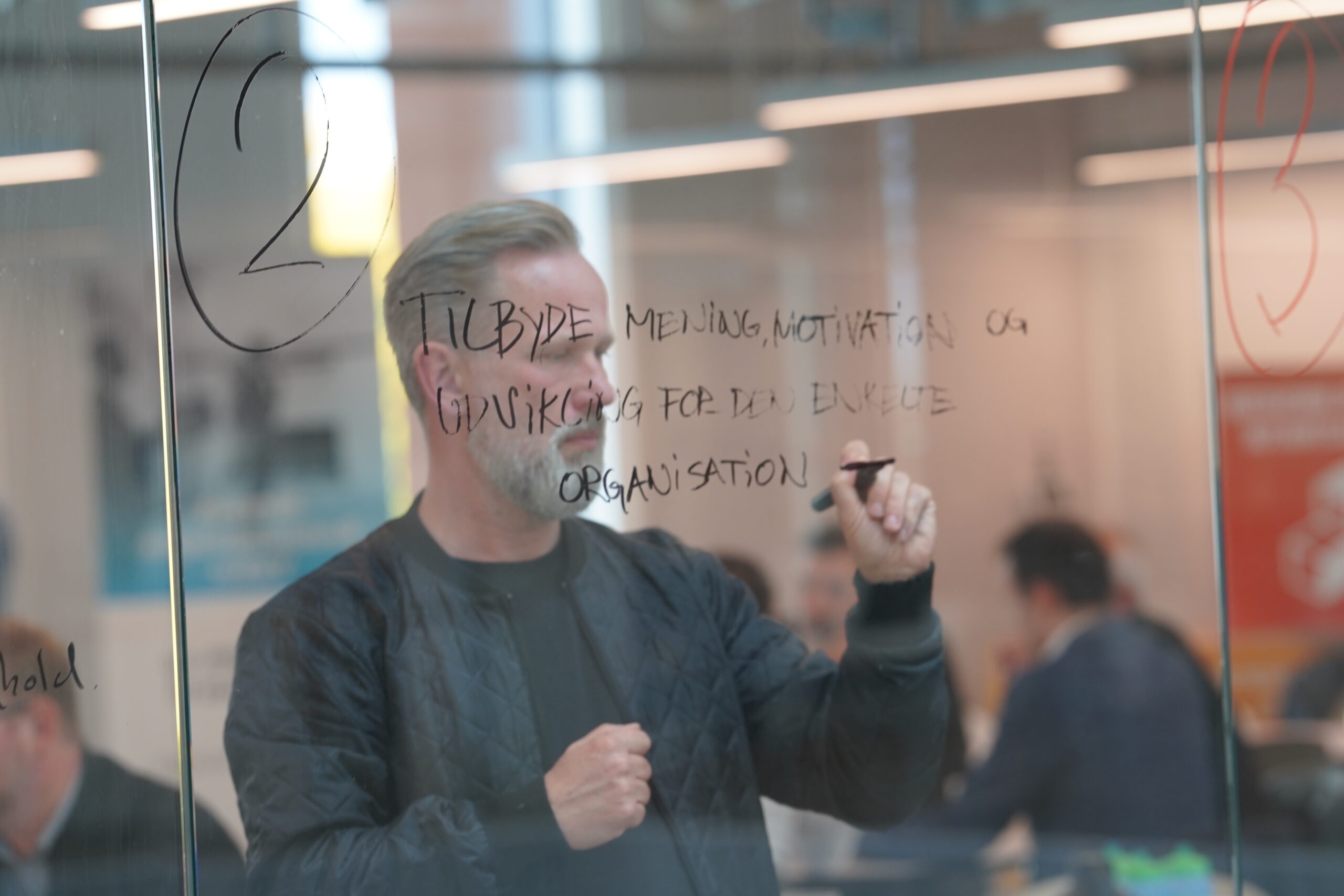
"Social change doesn't begin with a showdown, but with a movement," says Allan Klie, a member of the Danish Academy for Social Innovation ( Danish Social Innovation Academy ). For him, the Academy is a necessary space for reflection in the work of influencing systems from within.
When Allan Klie takes new people out sailing in his boat, he often finds that they make movements with the helm that are far too sudden and abrupt. These movements—contrary to their intended purpose—cause the boat to lose momentum. When he’s at the helm himself, however, he tries to work with the waves around him.
For Allan, navigating the waters is a direct parallel to social change. He believes that real change does not occur in sudden upheavals, but in small ripples that grow through relationships, through practice, and through engagement with the reality one wishes to change. This theme is reflected in his work as CEO of the Aspiranterne Foundation, where he uses culture, art, and strong communities to help young people in difficult life situations move forward.
Allan calls it “social navigation,” and it is at the heart of the Aspirants’ work: an approach based on the premise that change does not occur in a vacuum, but in a world marked by crises, shifting conditions, and unpredictable events. That is why it is impossible to set a fixed course and follow it slavishly.
“If, for example, I need to do something at a job center, I have to understand the reality they’re facing. We can’t just say, ‘Now we’re going to change everything, because this isn’t working.’”
STORIES OF CHANGE
How do we showcase the change we’re creating? This is a recurring question among many who work toward long-term change in society.
In 2026, the Academy for Social Innovation ( Danish Social Innovation Academy ) is working to create new narratives of change based on the Academy’s own work and the stories of its members. To this end, the secretariat has gathered knowledge and experiences from members through logbooks, qualitative interviews, surveys, and observations.
Throughout the year, you’ll have the opportunity to meet a number of members and learn more about what they take away from the Academy and the difference they make in society.
Read interviews with Anna Mollerup, director of Paths for Everyone; Torben Vind Rasmussen, chair of Efterskolerne ; and project manager Ania Stoltz-Andersen of TrygFonden
The Academy as a Space for Reflection
At “ Danish Social Innovation Academy ,” Allan has the opportunity to take a step back from the day-to-day routine and enter an open space where experiences are reflected upon, challenged, and developed together with other practitioners.
“As a leader, I find the Academy to be an inclusive space for reflection—something that can be hard to find in my day-to-day life otherwise. It provides insights that I can take back with me to my work at Aspiranterne.”
If we don't reflect on our actions, nothing will change.
– Allan Klie, The Aspiranterne Foundation
And even though the Academy doesn't provide ready-made solutions, there's a lot of action behind the scenes, says Allan.
“The Academy is also a forum for practitioners, where we have some communities of practice. For example, when I choose to join the Academy’s working group on activism, it’s because it deals with issues that are also relevant to my organisation.”
It is precisely this interplay between action and reflection that is crucial, and he consciously works to create the same balance between spaces for production and spaces for reflection in his * organisation*.
“If we don’t reflect on our actions, nothing will change. Then we’ll just have to start over every time.”
Small changes, big impact
In practice, the Aspirants’ evolutionary approach means that change often starts small. Within the employment system, Allan Klie has worked closely with case workers and young people for several years. Instead of demanding major systemic changes from the outside, he has insisted on demonstrating alternatives in practice.
Slowly, it has made an impact. Case workers are beginning to listen differently. New approaches are emerging, such as community groups for young people or a different approach to the conversations.
“Now they understand that it’s also everything else that matters. In the past, everything was focused on education—that is, ‘What do you want to be?’ Now we can talk about ‘Who do you want to be?’”
Earlier in his career, Allan Klie took a more confrontational approach. His ambition was to change systems quickly and fundamentally. But experience has taught him that change that is forced through suddenly or over a short period of time risks facing strong headwinds and foundering.
“At one point, I worked with a chef who had previously been at Noma. He said that the reason Noma has remained so exclusive is that they push the boundaries in too many areas at once. You have to eat deep-sea fish, smoke, and an ant all at the same time. Sometimes, an ant on a meatball is enough.”
When you try to change too much at once, the system loses its energy. When you work gradually, however, you create an opportunity for new practices to take root. This also applies when dealing with public systems. Here, the goal is not to overturn the structures, but to understand them and work with them.
The Leader as an Activist
At the Academy, he has had the opportunity to explore how he, as a leader, can take a more activist approach and help create movements.
“I’ve incorporated that into our ‘ organisation.’ Among other things, the practical action groups, where we figure out that we’d like to take collective action.”
We can't just say, "Now we're going to change everything,"
because this isn't working
– Allan Klie, The Aspiranterne Foundation
Specifically, Allan has been directly inspired by his great role model, Vincent Stanley, Chief Philosophy Officer at the activist outdoor company Patagonia. In a conversation with the Academy’s working group on activism, the two discussed the role that companies can play in the world, particularly with regard to climate and sustainability.
Together with the other members of the working group, Allan co-authored the op-ed “The Time Calls for Activism. What Is Our Responsibility as Leaders?” In it, the group outlined how leaders and organisations can contribute to social change by building competencies and capacity for activism—without, it should be noted, taking the floor away from those who are fighting to be heard.
Allan Klies’ understanding of change also shapes the way he organizes his work at the Aspranterne Foundation. Here, he is careful not to create a traditional “ organisation ” with fixed structures and clear boundaries. Instead, he works to build a movement.
“I’d rather see ‘Aspiranterne’ as a movement than a ‘ organisation.’ We need to seize the moment and respond to it, whether it involves young people, local governments, or cultural institutions.”
Allan Klie
Allan Klie is an actor, former theater director, and current director of the for-profit foundation Aspiranterne (2020–). He was a permanent member of the Odense Theater company from 1991 to 1998 and of the Aalborg Theater until 2001. Later, he produced a number of productions at Københavns Musikteater, where he served as artistic director from 2008 to 2017. He has also worked as a cultural developer and youth mentor at Askovfonden KBH+ and taught creativity at universities in both Denmark and Russia.
Allan has been a member of the Danish Academy of Arts ( Danish Social Innovation Academy ) since 2024 andis part of the Academy’s working group on activism.